Letter recognition activities, starting with a few letters
Published 2026-10-16 · Updated 2026-10-16
Help a preschooler recognize letters by teaching a few at a time, names and sounds together, with the child's own name as the first set.
Names, then a full set
By five years, the CDC says most children name some letters when you point to them, and write some letters in her name. Those two milestones are the practical start: the letters in the child's name, then other letters the child sees often, such as the first letter of a favorite snack.
The Institute of Education Sciences practice guide on foundational reading skills says students need to name the letters of the alphabet as they appear in print, and identify each letter's corresponding sound. It also says that once students know a few consonant and vowel sounds and their corresponding letters, they can start to sound out and blend those letters into simple words. Stay with those few letters until the child can name them when you point.
Many children are already playing with spoken parts of words. The same IES guide notes that many students will start breaking words into syllables in preschool. Clap the parts of "cupcake" or the child's name before you ask for the letter that starts the word.
Sound and print together
The IES guide recommends developing awareness of the segments of sound in speech and how they link to letters. Say the letter name, then the sound, then a word that starts with it. "M, /m/, milk." Point to the letter while you say it so the print and the sound land together.
Rhymes support that ear work. The CDC five-year list includes uses or recognizes simple rhymes, and the tips suggest playing rhyming games, such as asking what rhymes with cat. The four-year language list includes says some words from a song, story, or nursery rhyme. A song the child already knows is a letter lesson if you pause on one letter.
If letter names worry you, or the child has lost a language skill, talk with your child's doctor and ask about developmental screening, as the CDC five-year milestones page asks families to do.
Games with a few marks
Keep each game to one or two letters.
- Name hunt. Write the child's name in large letters. Ask the child to point to one letter. The five-year CDC milestone of writing some letters in the name is the reason this game comes first.
- Sound sort. Two letter cards, a basket of pictures or objects. The child puts the object by the letter that starts it. That is the letter-sound link the IES guide treats as necessary for reading words.
- Sign walk. On a walk, find one letter on signs and packages. Name it when you see it.
- Trace later. After the child can point to the letter, a tracing row can repeat the strokes. Tracing a letter the child cannot name yet is copying, not recognition.
Read aloud still matters
Read a picture book and let the child tell the story from the pictures. The CDC five-year tips suggest encouraging the child to "read" by looking at the pictures and telling the story, and asking what is happening in the picture. Point to one target letter in the title. That is enough print for one sitting.
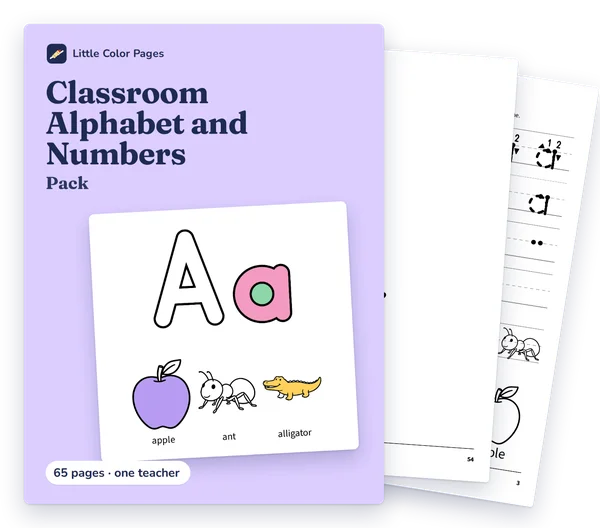
A teacher who wants a page for each letter can use the Classroom Alphabet and Numbers Pack ($11.00). It has 26 letter coloring pages, each with a big capital and small letter and three labelled pictures that start with it, plus 26 trace-and-find pages. One teacher may print unlimited copies for their own students, any school year. This classroom download is not a curriculum, and it promises no learning outcome.
Counting in the same small-to-larger order is in counting activities for preschoolers.
What are some ideas for letter recognition activities?
Find letters in the child's name, match a letter card to a picture that starts with its sound, and hunt for one letter on signs during a walk.
How to introduce letter A to preschoolers?
Show the letter, say its name and its sound, and find it in a name or a book. One new letter at a time is enough.
What are some activities to learn letters?
Read aloud, play rhyme games, sort a few letter cards, and trace only after the child can point to the letter.
Sources
- Foundational Skills to Support Reading for Understanding in Kindergarten Through 3rd Grade, Institute of Education Sciences (2016)
- Milestones by 5 Years, Centers for Disease Control and Prevention (2026)
- Milestones by 4 Years, Centers for Disease Control and Prevention (2026)