Little-prep activities for two-year-olds at home
Published 2026-10-16 · Updated 2026-10-16
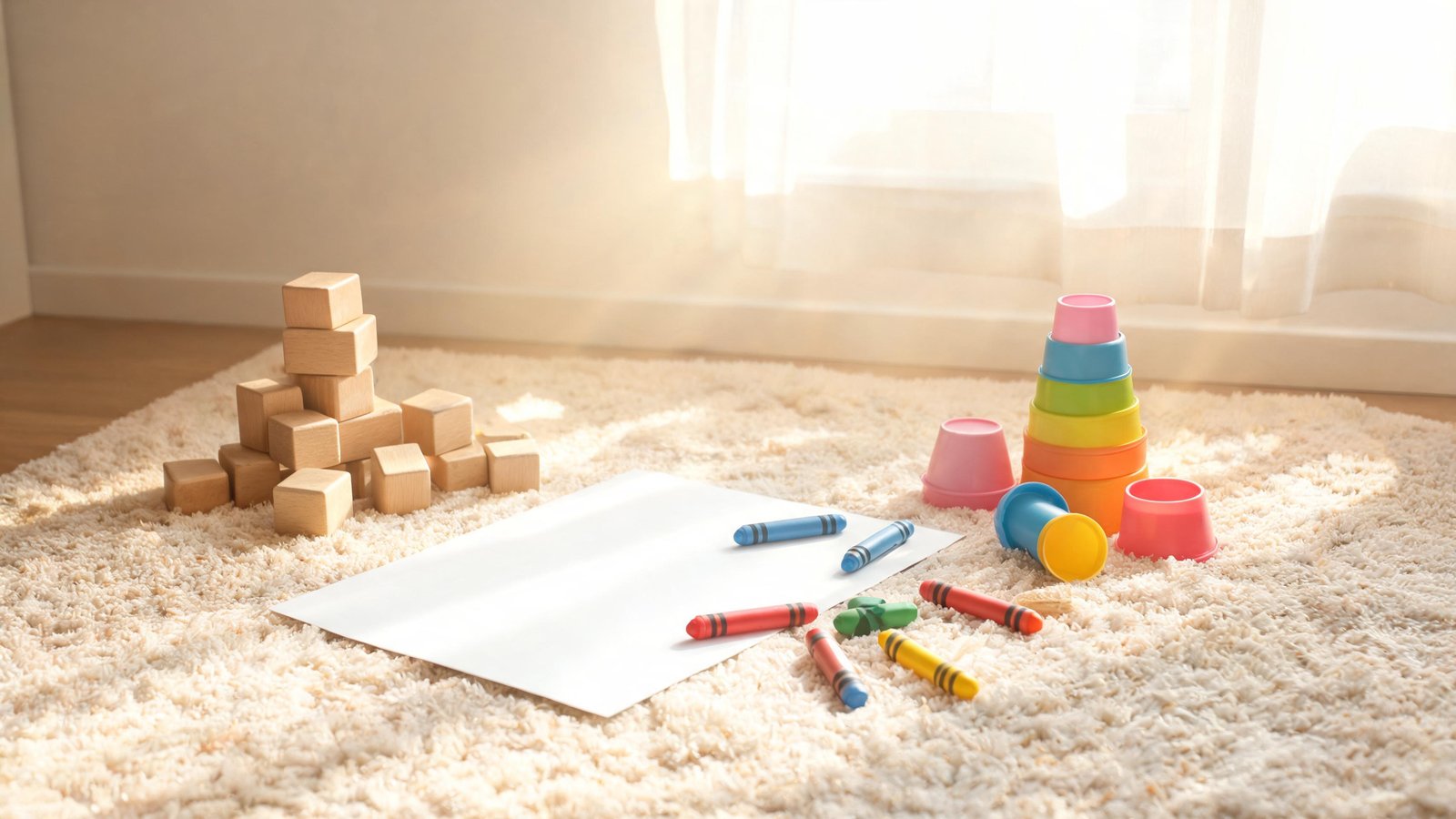
You can fill this afternoon with things already on the floor. Sort socks by color, roll or kick a ball, stack cups, or set a crayon on a big sheet of paper. None of that needs a bin, a recipe, or a shop run.
Keep rice, paint, and water for a window when you can stay beside them. Dumping the bin is the play, so plan for the dump.
The CDC milestone page for this age points to balls to kick, roll, and throw, block towers you build and knock down together, and simple puzzles with shapes, colors, or animals. That is the no-prep core.
No-prep floor play
- Color piles. Empty a basket of socks or toy animals and ask for the red ones in one heap. Say the color while the item moves.
- Ball games. Kicking a ball is on the CDC list of movement milestones for this age, and that page also says to offer balls to kick, roll, and throw.
- Cup stacks. A tower of plastic cups, nested or knocked down, uses both hands and nothing you have to buy.
- Block turns. Add one block, then let them add one, then knock the tower down. The CDC page names that game.
- Dress-up hats. Hats, shoes, and shirts on the floor start pretend play, which the same page recommends.
- Body-part song. Sing "Head, Shoulders, Knees, and Toes," touch a part, and wait. The CDC tip is to see whether a few of the words come back.
- Swing cue. On a swing, pull back, say "ready, set," pause, then "go" as you push. That listening game is on the CDC list.
- Meal helper. Plastic cups or napkins carried to the table count as helping get ready for a meal, which the CDC page suggests.
One-minute setups
These use one household object and a minute of your hands.
- Paper-ball transfer. Wad newspaper, tape the wads, and move each ball from one box to another. Play ideas from ZERO TO THREE for the second year use this fill-and-dump game so the hands cross the body.
- Freeze dance. Start a song, then stop it. Stopping and starting is that page's listening game.
- Leaf basket. A short walk with a small basket, picking up leaves, is the outdoor idea on that page. Walking, squatting, and pinching happen together.
- Cup hide. Cover a toy with one plastic cup, then try two. That page calls it a shell game and says to stay patient, because finding the hidden toy is hard at this age.
- Tube play. An empty wrapping-paper tube, a scarf pulled through, or a foam block dropped down it, is another idea from that page. The tube games there use a scarf or a foam block.
- Pouring practice. A washed spice jar with a few pieces of cereal, tipped onto a tray, is the pouring game on that page. Stay next to the tray while the cereal is out.
Messy play, only if you want it
Use this list only on a day you can stay in the room.
- Wet sponges outside. ZERO TO THREE says it is critical to supervise children carefully during water play, including sponge washing of a trike or a doll.
- Sand or tub containers. The CDC page says to offer sand toys or plastic cups, spoons, or a funnel in the tub or a sandbox. Stay for the whole turn.
- Dots and smears. Finger paint on one sheet, or a crayon used the same way, matches the art the CDC page describes: spreading color and making dots, then hanging the page where it can be seen.
- A seed pot, if you like dirt. ZERO TO THREE suggests grass or flower seeds in a pot for toddlers who want to shovel and pour. That one is messy on purpose.
First crayons
A picture of a cow can wait. The CDC page for this age says to give crayons or finger paint and let the child explore by spreading color and making dots. Dots, lines, and a page of one color are the activity.
HealthyChildren lists scribbling spontaneously among hand and finger skills on its two-year milestone page. That page is asking for marks on paper, not a school pencil grip.
Sit close enough to name the colors that show up.
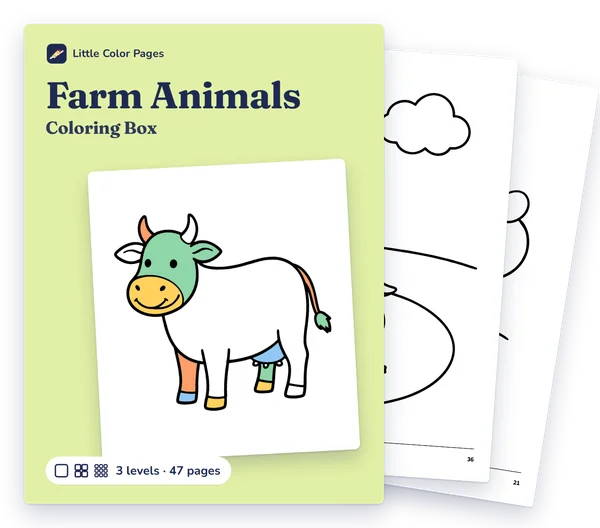
Big open shapes suit a child who is still making dots. The Farm Animals Coloring Box offers coloring pages and simple activities for a child aged about 2 to 6 who loves farm animals, at three detail levels, with 47 pages in separate US Letter and A4 PDFs, for $3.00. Age levels on the Farm Animals Coloring Box describe how much detail a page has; they are a guide, not a learning claim.
What two-year-olds are practicing
Treat the list as play targets, not a score. The CDC says these milestones are things most children can do by a certain age, and that the lists are not a substitute for a validated screening tool.
On that page, the two-year set includes saying at least two words together, pointing to things in a book, kicking a ball, running, eating with a spoon, and playing with more than one toy at once. If a skill has gone away, that CDC page says to talk with the child's doctor and ask about developmental screening.
Side-by-side play is the usual pattern, and sharing is still ahead. The CDC tip is to show turn-taking and to use words when you can.
Children's programs on a screen stay at no more than 1 hour a day, with an adult there, on that CDC page. A screen is not a stand-in for the floor list.
When the list is not enough
A child edging toward three, who wants counting or a longer story, can move to activities for three-year-olds. More finger work sits on fine motor activities for preschoolers.
This menu is a home afternoon, not a verdict on whether a child is behind. Compare milestones on the CDC page, and ask a doctor if you are worried.
What are some fun activities for toddlers?
Sort socks by color, roll a ball, stack cups, sing a body-part song, and scribble on a big sheet of paper. Those use what is already in the room.
What are some good cognitive activities for toddlers?
Hide a toy under a cup and let them find it, then hand over a shape puzzle and name each piece as it goes in.
What are some easy activities I can do at home with my 2-year-old?
Kick or roll a ball, build a block tower and knock it down, or carry plastic cups to the table together.
Sources
- Milestones by 2 Years, Centers for Disease Control and Prevention (2025)
- Play Activities for 12 to 24 Months, ZERO TO THREE (2026)
- Developmental Milestones: 2 Year Olds, American Academy of Pediatrics (2009)