Kindergarten readiness checklist, with practice for each item
Published 2026-10-16 · Updated 2026-10-16
Before kindergarten, look at self-care, getting along, talk, counting, letters, general knowledge, approaches to learning, and everyday health. Use gaps as practice, not as a verdict on starting school.
Skills to watch before school
The University of Missouri guide says every child develops at his or her own pace, and that its checklist should not be used to decide whether to enroll your child in kindergarten. The American Academy of Pediatrics says social, emotional, and behavior skills are equally critical to school success, and that kindergarten testing or screening should guide teaching rather than act as a gatekeeping test.
Watch these groups. Home practice sits beside each one.
Self-care. The Missouri guide asks whether the child can fasten clothing, dress, use the bathroom, and wash hands. The CDC's five-year milestones include buttons some buttons and does simple chores at home.
Getting along. The Missouri guide lists taking turns, sharing, and asking for help. The CDC lists follows rules or takes turns when playing games with other children. Practice is a short game with a clear rule, such as Simon Says, which those CDC tips also suggest.
Talk and books. The Missouri guide looks for talking in sentences, following two or three step directions, and knowing one's own name in print. The CDC lists tells a story with at least two events, and answers simple questions about a book or story after you read it. Read one picture book and ask what is happening.
Counting. The Missouri guide lists count up to ten objects and count to twenty aloud as examples, not as a pass mark. The CDC milestone is counts to ten, and names some numbers between one and five when you point to them. Count snacks, stairs, and toys, then point to a written numeral and ask its name.
Letters. The Missouri guide lists point to most letters of the alphabet and know that letters have sounds. The CDC lists names some letters when you point to them, and writes some letters in her name. Start with the letters in the child's name, a few at a time, while you read aloud.
Hands. The Missouri guide lists hold a crayon, marker, or pencil, and cut with scissors. The CDC lists hops on one foot. Drawing, cutting paper scraps, and outdoor play cover those items. A longer hand list sits in fine motor activities for preschoolers.
General knowledge. The Missouri guide asks whether the child knows the names of basic colors, the days of the week, and shapes such as a circle and a square, uses words like bigger and smaller, sorts objects by size, shape, or color, knows under, on, in, and out, and knows body parts. Name a shirt's color, point to today on a calendar, and sort lids into a bigger pile and a smaller pile.
Approaches to learning. The Missouri guide looks for enjoying new activities, a sense of curiosity, basic problem-solving such as getting another block to keep a tower standing, and keeping attention on an age-appropriate task such as building with blocks. Offer one new game, then sit nearby for a short block build.
Health. The Missouri guide asks whether the child gets enough sleep, eats a balanced diet, and brushes teeth. Keep a regular bedtime, serve a meal with more than one kind of food, and brush side by side.
If a milestone is missing, or a skill that used to be there is gone, talk with your child's doctor, share your concerns, and ask about developmental screening, as the CDC advises.
Papers some schools want
The Missouri guide says that, in Missouri, enrollment needs a birth or hospital certificate and an immunization record, and that you should contact your school district for other requirements. That list is Missouri's, not a national form. Your district's round-up is the place to confirm papers, bus rules, and the age cutoff.
Practice beside each item
Pick two unchecked items a week. Do them in real life first: buttons on a coat, a turn in a game, counting cups at snack, finding the first letter of the child's name on a sign, brushing teeth, or a short block build.
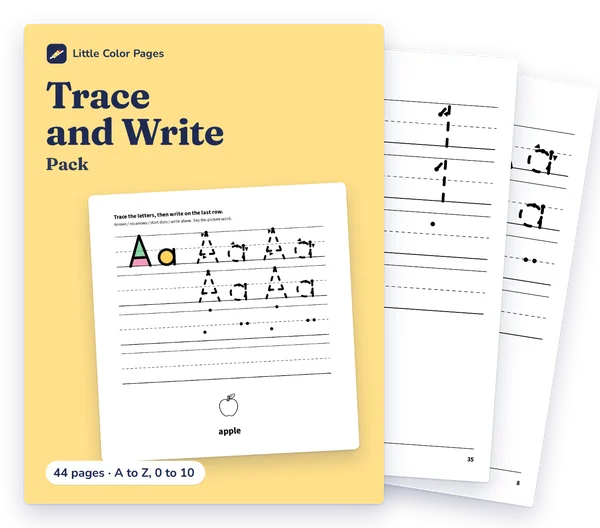
Paper practice can follow. The Trace and Write Pack ($2.00) includes pre-writing paths, a shapes tracing page, capital and small letters A to Z, and numbers 0 to 10 with step-by-step fading help. Those tracing pages are not a curriculum, and they promise no learning outcome.
A home preschool week, if you are still a year or two away from school, is sketched in homeschool preschool curriculum. Counting games in order are in counting activities for preschoolers.
What should a child know when going into kindergarten?
Public guides watch self-care, getting along, early talk, counting, letters, general knowledge, approaches to learning, and health. Missing items are practice targets, not a reason to stay home.
What do kids need to bring for kindergarten?
In Missouri, enrollment asks for a birth or hospital certificate and an immunization record. Ask your own district for the rest.
Sources
- Getting Ready for Kindergarten: A Guide for Parents and Teachers, University of Missouri, First Chance for Children (2021)
- Milestones by 5 Years, Centers for Disease Control and Prevention (2026)
- Is Your Preschooler Ready for Kindergarten?, American Academy of Pediatrics (2019)