Home activities for four- and five-year-olds
Published 2026-10-16 · Updated 2026-10-16
Match the activity to the child in the room, not to a birthday. A four-year-old often wants pretend play, color names, and a crayon held between fingers and thumb. A five-year-old can often count further, write some letters in a name, and stay with a story or a craft for a short stretch. Both still need to move through the day.
Pick by the child in front of you
By four years, the CDC lists pretending to be someone else, naming a few colors, drawing a person with three or more body parts, and holding a crayon or pencil between fingers and thumb rather than in a fist. Catching a large ball most of the time, unbuttoning some buttons, and serving food or pouring water with an adult watching are on that list too.
By five years, the CDC list adds counting to 10, naming some numbers between 1 and 5 when you point to them, writing some letters in a name, hopping on one foot, and paying attention for 5 to 10 minutes during a story or a craft. Screen time is excluded from that attention example.
Other sources emphasize different expectations, so these lists are not interchangeable age tests. Penn State Extension says four-year-olds may hop on one foot, count seven things, and work at one activity for ten to fifteen minutes. The CDC places hopping on one foot in its five-year list, with an attention window of 5 to 10 minutes. Use the overlap as play ideas. If you are worried a skill is missing, the CDC milestone pages say to talk with the child's doctor.
Four-year-old play that still works
- Color, shape, and size talk during an ordinary day. The CDC four-year tips say to ask the color, shape, and size of things the child sees.
- Count fingers, toys, or bananas. That page says simple counting helps with numbers.
- Answer the "why" questions, or say you will look it up together in a book.
- Choices of two or three: what to wear, what to play, or which snack. The CDC page says to keep the menu of choices short.
- A calm bedtime keeps screens off for 1 to 2 hours beforehand, and the CDC four-year page pairs that with 10 to 13 hours of sleep a day including naps.
- Read and ask what is happening and what might come next.
What often shows up around five
- Counting to 10, and naming some numbers between 1 and 5 when you point to them. Both are on the CDC five-year list.
- A made-up story with at least two events, and rhymes such as bat and cat.
- Rules in a simple game: taking turns, Simon Says, or a short board game. The CDC five-year tips include those.
- Memory games such as I Spy, tic-tac-toe, or hot and cold. That page lists them as attention play.
- Doing a small job even if it is imperfect: a bed, a button, or water poured into a cup. The tip is to celebrate the attempt and to fix only what you must.
- Looking at pictures and telling the story, which that page calls "reading" in quotes.
A five-year-old who wants letter games can also use letter recognition activities.
Pencil games at the table
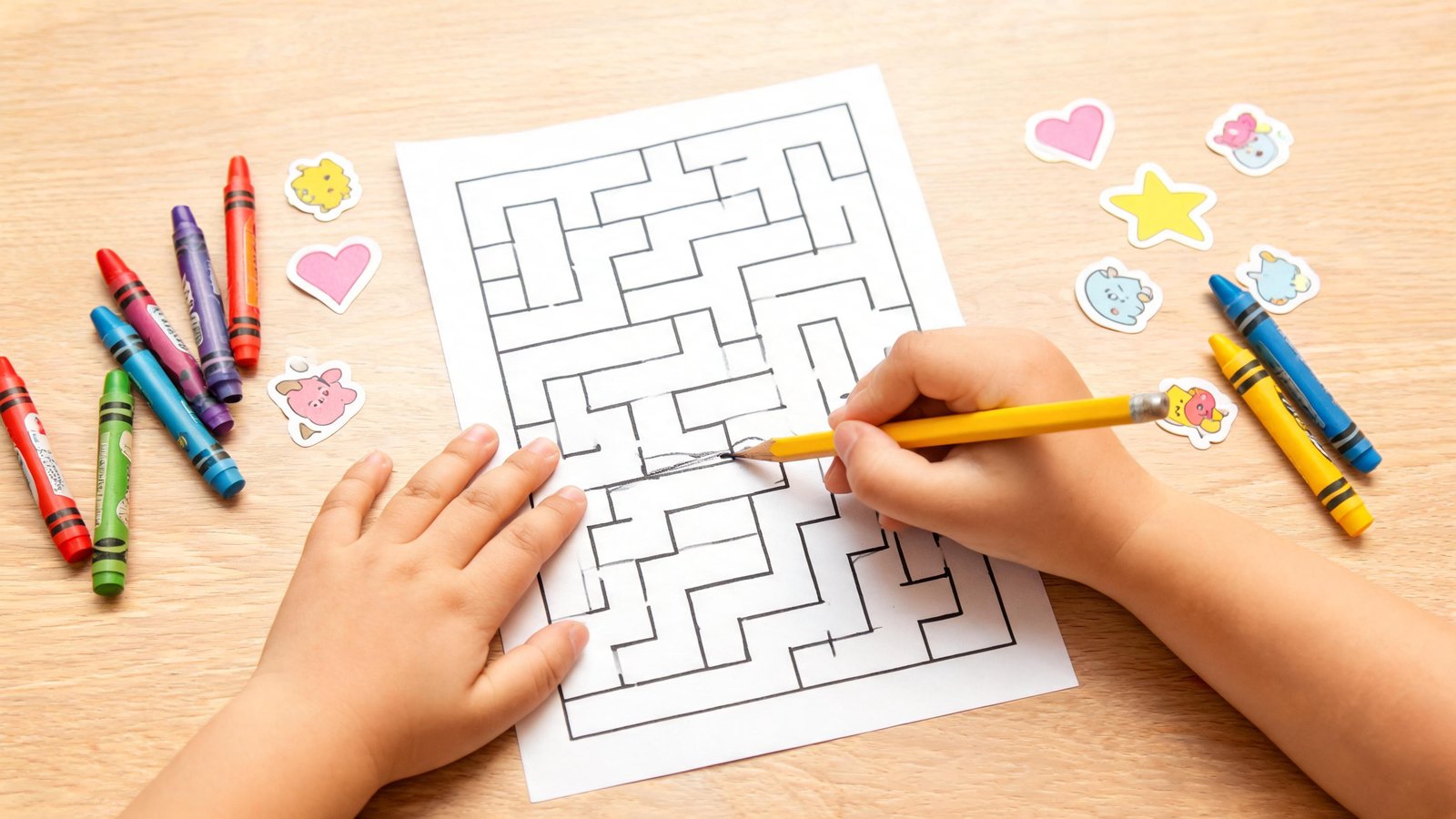
The finger-and-thumb hold on the CDC four-year list is the reason mazes and dot-to-dots start to fit. A wide path is enough at first. A grid maze or a long dot picture can wait until the child asks for it.
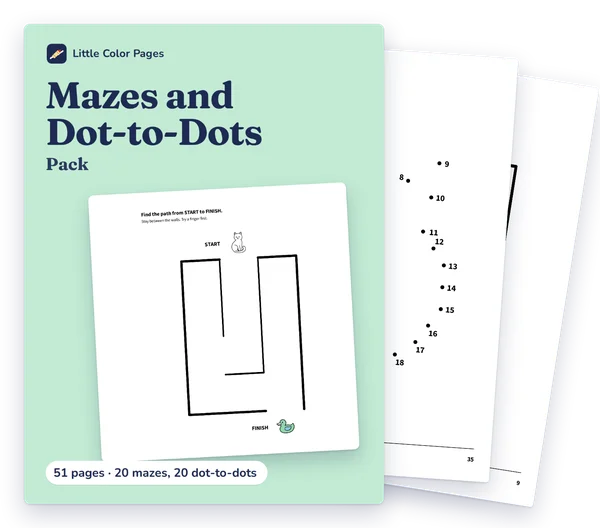
The Mazes and Dot-to-Dots Pack offers mazes and dot-to-dots for a child aged about 2 to 6, from wide easy paths to grid mazes and 1 to 30 dot pictures, with 51 pages in US Letter and A4, for $2.00. Age levels on the Mazes and Dot-to-Dots Pack describe difficulty; they are a guide, not a learning claim.
Penn State Extension tells adults to give four-year-olds paper and notepads for writing, and it says some children this age may print their own name. How the fingers sit on the pencil is covered in more detail on tripod grasp.
Pretend jobs and helper work
Pretending to be a teacher, a superhero, or a dog is a four-year social milestone on the CDC list, and liking to be a helper is on that list too. Empty food boxes become a grocery store, a restaurant, or a clinic. Penn State Extension suggests those prop boxes, plus books to look at alone.
Pouring water and serving food need an adult in the room. The CDC four-year milestone says that serving or pouring happens with adult supervision. Penn State Extension adds that four-year-olds can overestimate what they can do, so close supervision still belongs in the plan.
Outdoor games that use rules
Tag, follow the leader, and hide and seek are the outdoor games on the CDC four-year tips. A nature sort of sticks, leaves, and stones by color or shape uses the color-naming tip indoors after the walk.
If the child is younger and the pencil games frustrate, step back to activities for three-year-olds. A readiness list, if that is the real question, is on kindergarten readiness checklist.
These activities are a home menu. They are not a kindergarten test, and the age bands on a printable are a difficulty guide, not a promise that a skill will appear.
What are some fun indoor games for pre-K kids?
Blanket forts, freeze dance, pretend shops made from empty boxes, and a maze or dot-to-dot at the table.
What are some fun activities for 4-year-olds?
Name colors on a walk, play tag, pretend to be a helper, and draw a person with several body parts.
How to entertain a 4 year old at home?
Switch among pretend play, a short table job, and a moving game. One activity is rarely enough for a whole afternoon.
Sources
- Milestones by 4 Years, Centers for Disease Control and Prevention (2025)
- Milestones by 5 Years, Centers for Disease Control and Prevention (2025)
- Fun with four-year-olds, Penn State Extension (2026)
- Child Activity: An Overview, Centers for Disease Control and Prevention (2025)